In five years, 90% of funding will be done by machines

You may disagree with the number of years or the percent, but everyone understands that automation in the funding and collateral space is occurring at a fast pace. The question is how you prepare for this inevitable future? Our view is that connecting data from disparate sources is the key to the next evolution in the funding markets. A guest post from Transcend.

Who in the capital markets industry isn’t seeking greater profitability or returns? From balance sheet pressures and competitive dynamics to more resources to comply with regulation, focusing on transformative change to advance the firm has been a huge challenge. At the same time, technology is evolving at a rapid pace and the availability of structured and unstructured data is presenting a whole new level of opportunities. For firms to realize this opportunity, connecting disparate data and adopting smart algorithms across the institution are a critical part of any strategy.

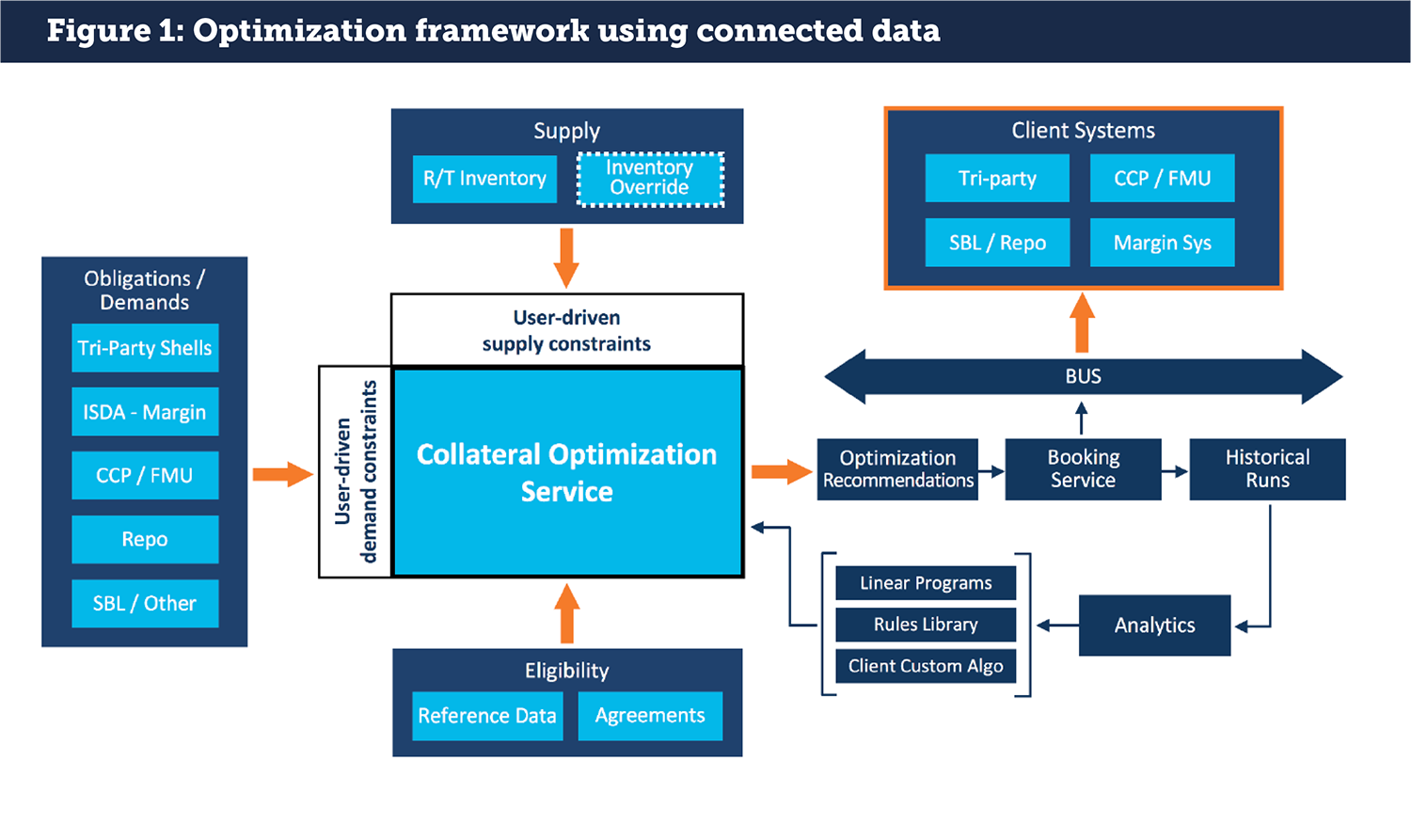
Advances in technology have allowed data to be captured and presented to traders, credit, regulators, and operations. But right now, most data are fragmented, looking more like spaghetti than a coherent picture of activity across the organization. Individual extracts exist that sometimes cross silos, but more often cannot be reconciled across sources or users. To be effective, data needs to flow from the original sources and be readable by each system in a fully automated way. It does not matter if individual systems are old or new, in the cloud or behind firewalls, from vendor packages or in-house technology: they all have to work together. We call this connected data.

Businesses have understood for some time that this will require growth of automation, which will be a critical driver of success. Banks and asset managers know that they have to do something: doing nothing is no option at all. Machine learning and artificial intelligence are part of the solution, and firms have embarked on projects large and small to enable automation under watchful human eyes. The new element to consider in the pace of change is the ability of machines to connect, process and analyze data within technology platforms for exposure management, regulatory reporting and pricing. The more data that feeds into technology on the funding desk, the more that automated decision-making can occur.

While individual systems and silos can succeed on their own, a robust and integrated data management process brings the pieces together and enables the kinds of decision-making that today can only be performed by senior finance and risk managers. Connected data is therefore possibly the most important link between automation and profitability. It is a daunting task to consider major changes to all systems that are in play, but most firms are adopting a strategy to build a centralized platform that brings data from multiple businesses and sources. A key benefit of this strategy is that advances in technology and algorithms can be applied to this platform, enabling multiple businesses or potentially the whole enterprise to benefit from this investment.

The risk of inaction

Connected data can stake its claim as the new, most competitive advantage in the markets. Like algorithmic trading and straight-through processing, which were once novelties and are now taken for granted, the build-out of a connected data architecture combined with the tools to analyze data will initially provide some firms with an important strategic advantage in cost and profitability management.

With all the talk about data, there is an important human element to what inaction means. In a data-driven, technology-led world, having more or all the right people will not stop a firm from being left behind, and in fact may become a strategic disadvantage. The value of automation is to identify a trade opportunity based on its characteristics, the firm’s capital and the current balance sheet profile. Humans cannot see this flow with the same speed as a computer, and cannot make as fast a decision on whether the trade is profitable from a funding and liquidity perspective. While the classic picture of a trader shouting across a room to check whether a trade is profitable makes for a good movie scene, it is unwieldy in the current environment. A competitor with connected data in place can make that decision in a fraction of the time and execute the trade before the slower firm has brought the trade to enough decision-makers to move forward.

The competitive race towards connected data means that firms with more headcount will see higher costs and less productivity. As firms with efficient and automated funding decision tools employ new processes for decision-making, they will gain a competitive advantage due to cost management, and could even drive spread compression in the funding space. This will put additional pressure on firms that have stood still, and is the true danger of inaction at this time.

Action items for connected data

Data is only as good as the reason for using it. Firms must embark on connecting their data with an understanding of what the data are for, also called foundational functionality. This is the initial building block for what can later become a well-developed real-time data infrastructure.

Each transaction has three elements: a depository ladder for tracking movements by settlement locations; a legal entity or trading desk ladder; and a cash ladder. Each of these contain critical information for connecting data across the organization. If your firm has a cross-business view of fixed income, equities and derivatives on a global basis, then you are due a vacation. We have not yet seen this work completed by any firm, however, and expect that this will be a major focus for banks through 2019 and 2020.

Ultimately, an advanced data infrastructure must provide and connect many types of data in real-time, such as referential data, market data, transactions and positions. “Unstructured” data, such as agreements and terms, capital and liquidity constraints, and risk limits, must also be available more broadly for better decision-making, despite their tendency to be created in some specific silo. But an important early step is ensuring visibility into global, real-time inventory across desks, businesses, settlement systems and transaction types; this is critical to optimize collateral management. Access to accurate data can increase internalization and reduce fails, cutting costs and operational RWA. This is especially important for businesses that have decoupled their inventory management functionality over time, for example, OTC derivatives, prime brokerage and securities financing. Likewise, the ability to access remote pools of high-quality assets, whether for balance sheet or lending purposes, can have direct P&L impacts.

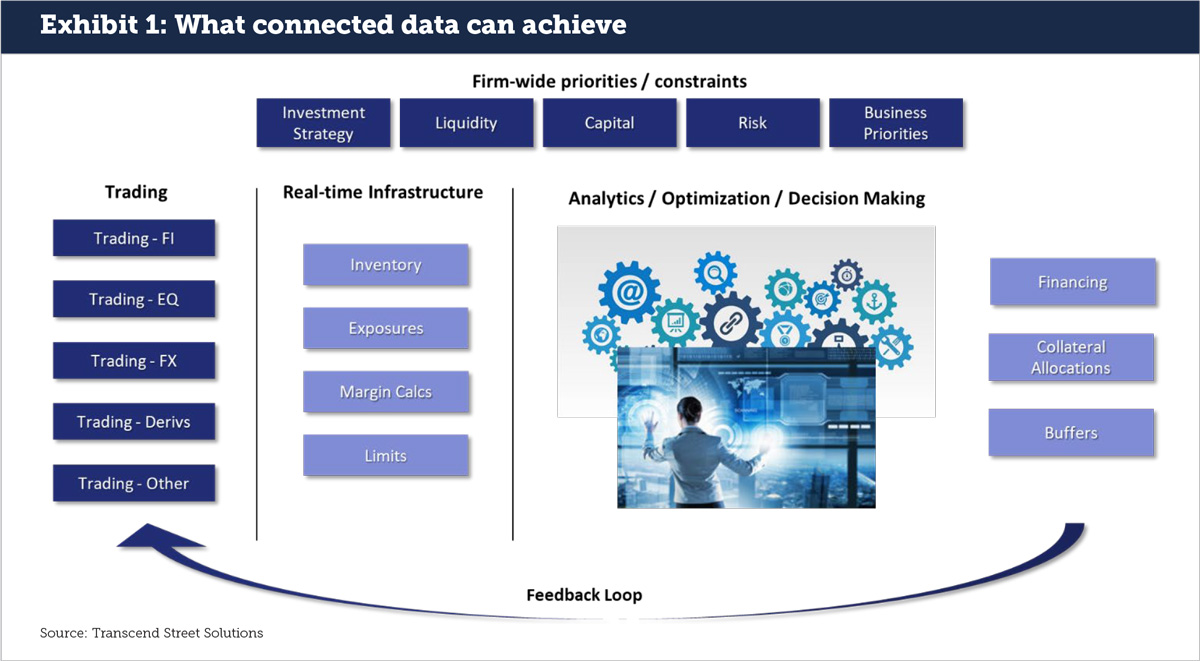
Step two is the development of rules-based models to establish the information flows that are critical to connecting data across a firm and simultaneously optimizing businesses on a book, business entity, and firm levels. The system must understand a firm’s flows and what variables they need to monitor and control within a business line and across the firm. Data will push in both directions, for example to and from regulatory compliance databases or between settlement systems and a trader’s position monitors. Rules-based systems simplify and focus on what is otherwise a very complex set of inter-related and overlapping priorities (see Exhibit 1).

Connected data can enable significant improvements such as:

  • Regulatory models can be fed on a real-time pre-trade “what-if scenario” so businesses can know how much a particular trade absorbs in terms of capital, liquidity or balance sheet for the given return, or if a trade is balance sheet-, capital- or margin-reducing.
  • Data can feed analytics that tells a trader, salesperson, manager or any stakeholder what kind of trades they should focus on in order to keep within their risk limits, with information on a granular client level.
  • XVA desks, the groups often charged with balancing out a firm’s risk and capital, can not only be looped in but push information back to a trader in real-time so they can know the impact of a trade.
  • Systems that track master agreements can be linked and analytics can point toward the most efficient agreement to use for a given trade.
  • Trading and settlement systems can interface with market utilities, both backward and forward.
  • Transfer pricing tools can be built into the system core and be transparent to all stakeholders with near instantaneous speed, at scale.

Transcend’s recent experience with some of the top global banks shows the value of consolidating data into one infrastructure. We are connecting front- and back-office to market infrastructure and providing information in a dashboard, in real-time. As trades book on the depository ladder, key stakeholders can see the change in their dashboard application and can make decisions on funding manually or feedback new parameters to pricing models across the enterprise. The same transaction and positions affect the real-time inventory view from legal entity or customer perspectives as well as driving cash and liquidity management decisions. Over time, as banks get more comfortable with their data management tools, parts of decision-making that follow specific rules can be automated. This will be an excellent deployment of the new data framework.

Betting on the time or the percent

As machine learning and AI advance, and connected data becomes more of a reality, technology platforms will learn how to efficiently mine and analyze data to understand if a trade satisfies institutional regulatory, credit, balance sheet, liquidity, and profitability hurdles. This will lead to an environment where a trade inquiry comes in electronically, is accepted or rejected, and processed automatically through the institution’s systems. The steps in this process are methodical, and there is nothing outside of what financial institutions do today that would prevent execution. A reduction in manual intervention can allow traders to focus on what is important: working on the most complex transactions to turn data into information and action.

The fact that more automation is occurring in funding markets is certain. The question at this time is how long will it take to automate most of the business. This is a bet on the timeline or the percent to which funding decisions can be automated but not the direction of the trend line. Could it be as much as 90% in five years? Answers will vary by the firm and some of the major players are already developing strategies to progress in this direction. Typically, people overestimate the impact of a new technology in the short term, but underestimate the impact in the long term. Banks have already invested in machine learning and AI tools to make automated funding a reality. But it will depend on the next and more complex step: to ensure that connected data can reach these tools, allowing for a robust view of positions, regulatory metrics and profitability requirements across the firm.

This article was originally published on Securities Finance Monitor.

View and/or download Article PDF

Transcend shortlisted for FTF News Technology Innovation Awards ‘Best Collateral Management Solution’

As firms look for ways to increase efficiency and reduce risk across the business, collateral often remains gridlocked. Transcend’s Collateral Management & Optimization solutions help firms completely redefine how they manage collateral – leading to increased liquidity, lower costs and greater compliance.

In recognition of our innovative approach, FTF has shortlisted Transcend for ‘Best Collateral Management Solution’ in the FTF News Technology Innovation Awards 2019, which celebrate noteworthy progress and achievements in operational excellence over the past year.

You can help decide who wins by voting here – look for Transcend Street Solutions in category 7, ‘Best Collateral Management Solution’. Voting closes on April 12.

Many thanks for your support!

Collateral management: A path littered with obstacles

As collateral rules have grown in complexity, so has the need for greater optimization – But as Tim Steele [of Funds Europe] discovers, achieving that can be painful.

Collateral has long been used as a tool for mitigating counterparty risk and obtaining credit, but now more than ever, it is the key determinant of an institution’s ability to engage in financial transactions in the cash or derivatives markets….

“If you optimize every pool or silo individually, as a firm you will by design not be optimized,” says Bimal Kadikar.

Read the full article from Funds Europe

QFC Recordkeeping Compliance: Top 5 Challenges and Benefits

With 2019 upon us, the first deadlines for banks to comply with the QFC Recordkeeping regulation are just around the corner. The final rule, detailed under the Dodd-Frank Act, will provide US regulatory authorities visibility into firms’ financial exposures and counterparty relationships to reduce the market risks and potential impact in the case of a major institution failing.

The regulation impacts all GSIBs, US DSIBs with $50B+ in assets, and foreign GSIBs operating in the US. It requires that they produce one consolidated report for all in-scope entities within a corporate group, capturing end-of-day positions of QFCs (qualified financial contracts) for in-scope products, along with their governing agreements, collateral, margin, counterparty info and related reference data. They must be equipped to do so on demand by the FDIC or US Treasury regulators, requiring unprecedented coordination, connectivity and data linkage across the enterprise.

Given so much focus complying with other myriad regulations, such as MiFID II, EMIR, SR 14/17 and SFTR, QFC Recordkeeping seems to have taken a back seat. But for firms operating in the US – even for “smaller” banks (i.e. assets in the $50B+ range) whose deadline might not be until 2021 – preparing for these data and operational hurdles demands their full attention now.

Top 5 Challenges for QFC Recordkeeping Compliance

  1. Identifying all in-scope products and data: QFCs cover a wide range of products, including swaps, repos, securities lending/borrowing, commodities, forwards, FX, options and more. Business units and front-to-back office functions must coordinate to identify all QFCs to ultimately aggregate the firm’s overall exposures.
  2. Digitizing legal terms of QFCs: For firms who don’t already have legal agreements digitized, or even a digital strategy yet in place, this is a significant and time-consuming undertaking. To link all QFCs to their corresponding legal agreements, firms must identify all required documents and have specific terms in digital format. In many banks, these contracts might have originated years ago, and potentially filed as paper documents. Where are they even stored? Maybe they were at least scanned. But you will need to source them and digitally extract and index required fields, plus organize them by Records Entity (RE) and their legal counterparties.
  3. Harmonizing and linking the data: Firms must capture all positions, agreements, collateral and reference data. To develop a comprehensive report, this data must be enriched, harmonized and integrated. Importantly, firms must link and retain mappings of the digitized agreement terms to their related QFC positions and/or posted or received collateral.
  4. Processing and aggregating exposure: It is necessary to aggregate positions and collateral for each netting agreement to determine net exposure for each Records Entity (RE) and their legal counterparties. The firm must also perform field-level validation against regulatory specifications before successfully generating FDIC or Treasury reports.
  5. Operationalizing reporting: Maintaining QFC data, linkages, processes and technology will be a new operational constant to satisfy on-demand requests from regulators. Upon receipt of requests, firms must be ready to upload a consolidated report that covers all in-scope entities. This also requires validating the FDIC/Treasury report for business context, remediating any errors and quickly addressing exceptions. The reports are filed in a stringent format of 8 tables and 128 fields of data and must be submitted by 7:00am the following day.

The Benefits Go Beyond Compliance

The QFC Recordkeeping requirement adds yet another compliance burden to many banks already managing numerous regulations. Fortunately, advanced, flexible technology available today facilitates compliance with minimal disruption to existing technology and internal processes – and in time for the deadlines. Ultimately, firms can reduce the costs, time and operational demands to meet the new QFC Recordkeeping rules.

But it doesn’t stop there.

The tremendous long-term benefits will more than reward the pains and invested resources in QFC Recordkeeping. This regulation forces firms to advance their enterprise data management goals by digitizing, aggregating, harmonizing and linking agreements, collateral and exposures. Though it seems burdensome, it may bring unprecedented transparency and coordination across business segments.

Ultimately, connecting data across agreements, trades and collateral will enhance multiple business functions and controls across the enterprise. In particular, some of the critical areas such as enterprise collateral funding and optimization, liquidity stress testing requirements, credit and counterparty risk management can significantly benefit from this holistic investment. As Winston Churchill said, “Never waste a good crisis,” and QFC Recordkeeping compliance is a great example. Firms that are in scope for QFC Recordkeeping compliance may have a rare opportunity to significantly enhance their data and business capabilities while complying to this difficult regulation.      

Learn more about QFC Recordkeeping compliance, or contact us to discuss in more detail.

Collaboration, Communication (and a Margarita?): The Catalysts for IT Innovation

Leadership, especially in critical, but technologically-challenged functions like collateral management, is the key to seizing a competitive advantage.

IT innovation doesn’t just happen, even in the capital markets where opportunities for substantial improvements in areas like collateral and liquidity management can lead to greater, measurable and sustainable returns. All IT innovation needs commitment, investment and a strategy to make a difference. But most importantly, it needs unwavering leadership if it is to deliver the competitive success it promises.

And here lies the conundrum.

Bank executives already allocate hundreds of millions of dollars (even billions) annually towards technology budgets, yet they are still being bombarded by the claims of a myriad of new developments and solutions that promise an elusive holy grail.

Strengthen Decision-Making

How should the business digitize, become platform-based and leverage open architectures to drive data management strategies that deliver intelligent information?  Finding the key to this will strengthen decision-making across all front-to-back office functions.

But it’s not surprising that there is resistance to change, with perennial questions to be answered such as: Why can’t we get more out of our existing IT estate? Will that spend even deliver half of what it promises? What disruption will there be to existing systems while this takes place and how long will it take?

These are understandable executive concerns, given the time consumed by regulatory compliance, the dynamics of a rapidly changing market, and constant pressures to reduce costs and improve margins. Also, not unnaturally, executives lean heavily on historically well-resourced internal IT teams to guide future decision-making, and hence investment.

But it still came as a shock to many when a 2015 Accenture Report estimated that 96% of bank board members had no professional technology experience, while only 3% of bank CEOs had any formal IT knowledge. At the same time, another study said that the top 10 banks have more IT personnel than the top 10 financial software vendors.

Some say that “ignorance is bliss”, but others counter, “If that’s the case why aren’t there more happy people about?” And this reveals the dilemma.

Define the Divide

A lack of IT and business alignment in banking has been a thorny subject for years, constantly framing the two sides as adversaries, rather than partners. These differences often create a chasm of understanding of the priorities, objectives and vision of “success” for each side, effectively stagnating progress toward the necessary transformation.

But there is a way forward.

Remove Gridlocks

Take, for example, collateral management. We know processes are often gridlocked, liquidity constrained, technology inflexible and access to pertinent data denied by historic silos and working practices. Every week we see how this results in lower capital returns and impaired profitability, at a time of increased competition and shrinking margins.

What used to be a straightforward back-office task to ensure sufficient and appropriate collateral has become mission-critical in pre-trade decision-making as constraints on capital, regulatory pressures and efficiency mandates demand optimized collateral deployment firm-wide.

But recognizing the problem is only the first challenge. Attempting to fix system pitfalls with a few bandages on already stretched legacy systems tends to compound the problem over time.

Trust External Expertise and Innovation

Experience shows that wider collaboration is feasible – and is working. Banks are now better able to lean on the expertise of outside IT vendor expertise, whose claims are not only battle-proven but are ones that complement rather than threaten internal teams. Developing collaborative partnerships with the business, internal IT and select external vendors who bring new ideas, innovation and experience to the table can significantly advance the firm’s technology objectives. Furthermore, there is a greater willingness to consider cloud-based solutions, as cost benefits and improved resilience start to outweigh historic operational risk concerns.

Align Talent with Objectives

This collaborative approach also benefits internal departments by enabling them to deploy talent where it can be most effective. It encourages the injection of fresh ideas into internal debates, complementing existing capabilities with a step-by-step series of tactical enhancements that eventually deliver a strategic objective – without undermining business opportunities or day-to-day operations.

If this leads to more effective data aggregation and analysis, there will be better-informed decisions that deliver tangible improvements to business profitability, while also reducing risk and bolstering regulatory compliance.

A fresh look at enterprise-wide technologies also lays the foundations for ongoing automation of critical business processes. By starting in a segment like collateral management that impacts all asset classes, business functions and jurisdictions, firms can enable each stakeholder across trading workflows to evolve and provide greater value to the broader enterprise.

This should not only produce a more effective and profitable business but a better informed and more confident executive team that is further empowered to deploy technology more widely to the best benefit of the business.

Once there, they can probably also have a laugh and raise a margarita to Jimmy Buffett, who one of my island-loving peers quotes: “Is it ignorance or apathy? Hey, I don’t know and I don’t care” – because by then everyone will know and they will care.

Risktech start-ups struggle to clinch big-bank contracts

Start-ups are widely reckoned to have a one in 10 chance of survival. For start-ups in the field of risk management, the odds are probably a little worse: the field has all the withering mortality of the ordinary start-up, plus the special hell of being small, agile and captive to the sluggish metabolism of a big bank.

For now, it’s not stopping them. Hoping for a big payoff, this group of disruptors is looking to upend risk management with their products, addressing things from transaction monitoring and trade reporting, to IFRS 9 and model validation.

Read the full article on Risk.net

Transcend Hires Former JPMorgan Securities Finance Exec Marcoullier

NEW YORK, NY (June 7, 2018) – Transcend, a leading provider of real-time collateral and liquidity management technology, has appointed BJ Marcoullier Head of Sales. In this role, Marcoullier will be responsible for driving the firm’s sales and business development efforts.

Before joining Transcend, Marcoullier spent 22 years at JPMorgan Chase, most recently leading its North American liquidity and funding team within equity finance and prime brokerage. He also led funding, liquidity and capital optimization efforts for its US broker dealers and prime brokerage business and managed the Americas securities borrow and loan desk.

“While some institutional functions have leapt forward in the last decade, the use and optimization of collateral remains gridlocked in days gone by,” said Marcoullier. “When deciding between options for my next role, Transcend’s combination of vision for making enterprise data aggregation, analytics and optimization a business-driving strategy and the technology to fulfill that promise was unrivaled.”

“BJ has a reputation for catalyzing change within one of the world’s largest institutions,” said Bimal Kadikar, CEO and Founder of Transcend. “He’ll be critical to expanding our business and a game changer to our industry as institutions develop strategies to analyze and optimize collateral more holistically.”

###

About Transcend

Transcend is a leading provider of real-time collateral and liquidity management technology. With a modular, front-to-back office approach, clients harness real-time data, collateral and liquidity across their enterprises to unlock greater efficiencies and improve returns on investments. For more information, visit www.transcendstreet.com.

Media Contact
Patrick Sutton
Paragon Public Relations
Patrick@paragonpr.com
+1.646.558.6226

Top five trends in collateral management for 2018

Collateral management has broadened far past simple margin processing; collateral now impacts a majority of financial market activity from determining critical capital calculations to impacting customer experience to driving strategic investment decisions. In this article, we identify the top five trends in collateral management for 2018 and highlight important areas to watch going forward.

The holistic theme driving forward collateral management is its central role in financial markets. Collateral has grown so broad as to make even its name confusing: where collateral can refer to a specific asset, the implications of collateral today can reach through reporting, risk, liquidity, pricing, infrastructure and relationship management. The opportunities for collateral professionals have likewise expanded, and non-collateral roles must now have an understanding of collateral to deliver their core obligations to internal and external clients.

We see a common theme running through five areas to watch in collateral management in the coming year: the application of smarter data and intelligence to drive core business objectives. Many firms have digested the basics of collateral optimization and are now ready to incorporate a broader set of parameters and even a new definition of what optimization means. Likewise, technology investments in collateral are starting to tie into broader innovation projects at larger firms; this will unlock new value-added opportunities for both internal and external facing technology applications.

Here are our top five trends for collateral management in 2018:

#5 Technology Investments

The investment cycle in collateral-related technology applications continues to grow at a rapid pace. Collateral management budget discussions are moving from the back office to the top of the house. And partly as a result, the definition of the category is also changing. Collateral management should no longer be seen as strictly the actions of moving margin for specified products, but rather is part of a complex ecosystem of collateral, liquidity, balance sheet management and analytics. The usual, first order investment targets of these budgets are internally focused, including better reporting, inventory management and data aggregation. The second derivative benefit of a more robust data infrastructure focuses on externally facing trading applications, including tools for traders and client intelligence utilities that provide real-time information and pricing for the benefit of all parties. This new category does not yet have a simple name, one could think of it as a “recommendation system” but regardless of name, this has become a major driver of forward-looking bank technology efforts and efficiency drives.

As large financial services firms capture the benefits of their current round of investments, they will increasingly turn towards integrating core innovations in artificial intelligence, Robotics Process Automation and other existing technologies into their collateral-related investments. This will unlock a large new wave of opportunity for how business is conducted and what information can be captured, analyzed, then automated, for a range of client facing, business line, internal management and reporting applications.

#4 Regulatory reporting

Despite being 10 years since the bottom of the great recession, regulatory reporting requirements for banks and asset managers continue to evolve. Largely irrespective of jurisdiction, the core problem facing these firms is aggregating and linking data together for reporting automation. Due to strict timeframes and complex requirements, firms historically relied on a pre-existing mosaic of technology and human resources to satisfy regulatory reporting needs. However, these tactical solutions made scale, efficiency and responsiveness to new rules difficult. The challenge of regulatory reporting is a puzzle that, once solved, appears obvious. But the process of solving the puzzle can create substantial challenges.

Looking at one regulation alone misses the transformative opportunity of strategic data management across the organization. Whether it is SFTR, MiFID II, Recovery & Resolution Planning requirements of SR-14/17 or Qualified Financial Contracts (QFCs), the latest initiative du jour should be a kick off for a broader rethink about data utilization. Wherever a firm starts, the end result must be a robust data infrastructure that can aggregate and link information at the most granular level. At a high level, firms will need to develop the capability to link all positions and trading data with agreements that govern these positions, collateral that is posted on the agreements, any guarantees that may be applied and any other constraints that need to be considered. Additionally, it has to be able to format and produce the needed information on demand. Achieving this goal will take meaningful work but will make organizations not only more efficient but also more future proof.

#3 Transfer pricing

As firms try to optimize collateral across the enterprise, it is critical that they develop reasonably sophisticated transfer pricing mechanisms to ensure appropriate cost allocations as well as sufficient transparency to promote best incentives in the organization. Many sell-side firms have highly granular models with visibility into secured and unsecured funding, XVA, balance sheet and capital costs. And in varying fashion these firms allocate some or all of these costs internally. But many challenges remain, including: how should all these costs be directly charged to the trader or desk doing the trade; and what is the right balance of allocating actual costs versus incentivizing business behavior that maximally benefits the client franchise overall. As we know, client business profiles change through time as do funding and capital constraints. There may be a conscious decision to do some business that may not make money in support of other areas that are highly profitable. Transfer pricing is evolving from a bespoke, business aligned process to a dynamic, enterprise tool. The effort to enhance transfer pricing business models continues to be refined and expanded.

Firms that embrace the next iteration of transfer pricing will achieve a more scalable, efficient and responsive balance sheet. This will include capturing both secured and unsecured funding costs, plus firm-wide and business specific liquidity and capital costs. Accurately identifying the range of costs can properly incentivize business behaviors beyond simply the cost of an asset in the collateral market. Ultimately, transfer pricing can be a tool to drive strategic balance sheet management objectives across the firm.

Functionally, implementing transfer pricing requires access to substantial data on existing balance sheet costs, inventory management and liquidity costs that firms must consider. Much like collateral optimization, the building block of a robust transfer pricing methodology is data. Accurate information on transfer pricing can then flow back into trading and business decisions to be truly effective.

#2 Collateral control and optimization

Optimization is evolving well beyond an operations driven process of finding opportunity within a business to an enterprise wide approach at pre-trade, trade and post-trade levels. Pre-trade, “what-if” analyses that will inform a trader if a proposed transaction is cost accretive or reducing to the franchise is important, but this requires an analytics tool that can comprehend the impact to the firm’s economic ecosystem. At the point of trade, identifying demands and sources of collateral across the entire enterprise extends to knowing where inventories are across business lines, margin centers, legal entities and regions. It also means understanding the operational nuances and legal constraints governing those demands across global tri-parties, CCPs, derivative margin centers and securities finance requirements.

In a simple example, collateral posted on one day may not be the best to post a week later; if posted collateral becomes scarce in the securities financing market and can be profitably lent out, it may be unwise to provide it as margin. A holistic post-trade analysis, complete with updated repo or securities lending spreads, can tell a trader about missed opportunities, leading to a new form of Transaction Cost Analytics for collateralized trading markets.

#1 Integration of derivatives & securities finance (fixed income and equities)

The need for taking a holistic approach to collateral management has led the industry toward significant business model changes. Collateral is common currency across an enterprise and must be properly allocated to wherever it can be used most efficiently. This means that traditional silos – repo, securities lending, OTC derivatives, exchange traded derivatives, treasury and other areas – need to be integrated. Operations groups that have been doing fundamentally the same thing can no longer be isolated from one another; the cost savings that come from process automation and avoiding operational duplication is too compelling.

On the front-office side, changes needed to impact trading behavior, culture and reporting to name a few are often very difficult to implement over a short period of time. Despite similar flows and economic guidelines, different markets and operation centers, even though all under the same roof, traditionally suffer from asymmetric information. To address this challenge a handful of large sell-side players have combined some aspects of these businesses under the “collateral” banner, sometimes along with custody or other related processing business. Others have developed an enterprise solution to inventory and collateral management. We expect that, more and more, management is seeing the common threads and shared risks involved. The merger of business and operations teams translates into a need for technology that can be leveraged across silos.

The business of collateral management is reshaping every process and silo it touches. While the trends we have identified are not brand new, they all stand out for how far and fast they are advancing in 2018 and beyond. Financial services firms that take advantage of these trends concurrently and plan for a future where collateral is integrated across all areas of the business will improve their competitive positioning going forward. To add a sixth trend: firms that ignore broader thinking about collateral management technology do so at their own peril.

This article was originally published on Securities Finance Monitor.

Revisiting the Importance of Inventory Management in Collateral and Liquidity

In this article in Securities Finance Monitor, Transcend’s CEO Bimal Kadikar discusses the opportunities for more effective liquidity and collateral management – and the potential benefits to the bottom line. A solid starting point is inventory management whereby firms can match collateral to needs, improve front-to-back office communications and increase operational efficiency and compliance.

Access the full report on Securities Finance Monitor.
To download this article, please click here.

A framework for build, buy or network in a changing market environment

Capital markets firms are faced with tough choices in their vendor and utility selection. But when should firms choose to partner with vendors, participate in industry utilities or insource development altogether? This article provides a framework for thinking through the options.

Capital markets have always been fast moving but seldom have the drivers of change come from so many directions at once.  Both buy-side and sell-side firms are contending with simultaneous pressures to comply with new regulations, find new ways to generate revenues and to cut costs. What makes this environment even more challenging is the interaction between these competing goals. Implementing new functionality to comply with new regulations is not enough; systems and processes also need to adjust to accommodate changes to business models driven by those regulations. New business initiatives have historically gone through due diligence processes of varying degrees of strictness and now need to satisfy control questions from the outside.  All this at a time when technology is evolving at a dizzying pace providing many options that were not viable until recently.

These challenges should not be perceived as all negative because the current environment presents many positive strategic opportunities. From established technology providers to the newest fintech start-ups, there is now an unprecedented choice of technology vendor options. There is a greater willingness than ever by firms to partner and develop industry solutions and to support, and in some cases create, new service providers. Meanwhile, at long last, the breadth of new functionality offered by these providers is matched by their depth of expertise. Solution providers frequently now offer not just “software” or a “service” but a complete solution package.

While capital markets players show increased willingness to turn to others for help in this challenging environment, there is also the recognition that the return on investment from internal technology resources needs to come from genuine differentiators in areas such as trading, data analytics, risk management and client interaction. In this world of both challenge and choice how can firms make the optimal choices without becoming stuck in analysis paralysis? At the most fundamental level they require a framework for deciding when to build, buy or network in collective enterprises.

Assessing internal capabilities

For a capital markets firm, the starting point for creating a framework is a realistic assessment of who they are, where they are going and what they are capable of. Some firms’ strengths may come from getting the basics right in areas such as operations or credit. Others may be innovators, creating new products, being the first into new markets or the first mover in the application of new technologies. Few, if any, firms can be good at everything and the effort of trying can be counterproductive. A realistic recognition of strengths and weaknesses is key.  This analysis needs to be conducted front to back ⎼ including business functions, personnel and technology capabilities ⎼ to ensure the most holistic understanding is developed for optimal decision making.

The next step is for a firm to understand where it wants to go, or more often in the current changing environment, where they need to go. Banks have been constrained by the pressure to build up and conserve capital. As a consequence, many formerly key business areas have shrunk or been closed. On the buy-side, active fund management, a traditionally high margin business, is under threat. Business changes such as the growth in popularity of low-cost ETFs and the rise of the robo-advisor are having major impacts on business strategy, even where the basics are sound. Whether a business strategy is expansive or reactive, or simply aimed at preserving a successful franchise, it has a major impact on a framework for interaction with technology and service providers.

Lastly, firms need to assess the potential of help from external parties versus the strengths of internal capabilities. One of the most significant recent developments has been the willingness to develop shared industry resources. The general driver for this has been a recognition that many parts of a financial sector organization (including the relevant parts of infrastructure) are non-differentiating sources of costs rather than sources of competitive advantage. Though industry utilities have been around almost as long as computers, they have tended to focus on a limited set of functional areas.

The new generation of utilities are appearing across front, middle and back office. Some notable examples include: FIS’s Derivatives Processing Utility which grew out Barclays; Accenture (in collaboration with Broadridge) Post-Trade Processing that absorbed business functions from Societe Generale; and more traditional projects such as Symphony, a collaboration of 16 major financial firms building a secure communication network. Another change of emphasis has been from the traditional regulatory drivers behind major utilities to more commercial drivers. In some cases, superior internal performance may actually create the opportunity for revenue generation by using that capability as the basis for an industry utility.

Creating vendor partnerships – dependencies, commodities and customization

There has been a high degree of consolidation of financial software vendors in recent years. Firms such as FIS have grown through a long-running series of acquisitions (notably SunGard at the end of 2015), Broadridge Financial Solutions continues to make acquisitions, and UK based Misys recently merged with Canadian D+H to form Finastra. Consolidation has also been driven to some extent by internal procurement departments, which in many large financial services firms have worked to reduce the number of vendor relationships.

Despite these trends, there has been little reduction in choice as new fintech vendor firms grow. “Innovation” or “digital” teams across capital markets firms have worked to build bridges to the more promising start-ups. Choice in functionality has been matched by choice in the type of offerings. Capital markets software is often now available as part of a comprehensive package including cloud-based hosting, integration and maintenance. Newer fintech firms may not be as big as other vendors but they make up for it with speed of execution, nimbleness and innovation in driving complex challenges. They are able to adopt some of the latest technology innovations much more efficiently than their larger counterparts.

Add to that the management of staff to execute the business process, and one end of the software services spectrum is indistinguishable from a utility. Still, partnering with a vendor creates the bane of any project manager: more dependencies on outside parties can mean more risks, the potential for slow turnaround and reduced control. The alternative, however, isn’t foolproof. Good internal development teams and working in genuine partnership with a business can deliver changes rapidly that are focused on a business user’s needs. However, writing new software or even carrying out the full integration of a vendor package can be a high risk and high-cost strategy.

A good amount of the current enthusiasm for partnering with new fintech firms or joining industry utilities come from few key factors:

  • The experience of difficulties rolling out new systems in financial firms’ increasingly controlled and complex environments.
  • Many fintech firms can offer significantly deep domain and technical experience that may not be available internally.
  • Many financial firms have difficulty in finding and retaining top technology talent as professionals have opted to pursue other opportunities in the broader technology industry or fintech space.

This can make it harder than ever to deliver a project to budget, with acceptable timescales and user expectations. Even where a firm shows expertise in one area of technology, it is unlikely to have breadth and depth of resources within its IT function to do everything to the same standard.

Commoditization or specialization

Depending on an honest assessment of the firm, its capabilities and business strategy, different choices may be made about buying, building or collaborating. If a capital markets firm’s need is for relatively standard, commoditized functionality, then the key factor becomes the gap between their offering and the firm’s needs. The wider the gap, the greater dependency on additional work being done and the greater the implementation risk. If a wide gap exists between the firm’s needs and the full range of offerings, it may be worth going back to basics and asking why its needs are so different to peers that make use of software packages or other services in the first place.

If one or more potential partners can provide the desired functionality, the characteristics of the vendors themselves need to be considered. Important variables will include vendor capabilities and skill sets in terms of business domain and technical innovation, reputation in the industry, and extensibility of architecture and offering.  Many large vendors provide full feature functionality but it may be hard to customize whereas some newer fintech firms are leveraging more flexible technologies to make their offering able to meet various needs. If a supplier can provide functionality that can then be extended by an internal team, it may be an advantage as firms don’t always need to rely on the vendor for critical business changes.

If businesses require more innovative solutions than they are capable of mustering internally, it is likely that a partner will be of benefit. But the characteristics of the partner may become the most critical factor. Any partner chosen needs to have a genuine understanding of the firm’s needs. Genuine understanding comes from the combination of both technical skills and real-world experience. Suitable partners also need to understand the value of building a solution that is not just for today but has the flexibility to adapt to tomorrow’s challenges. Regulatory changes, such as the requirement to report securities finance trades under SFTR and margining of FX Forwards as a result of MiFID II, can have dramatic impacts. On the positive side, market changes or the rapid uptake of a new product can still lead to dramatic increases in volumes. In this case, firms need to look for a partner and not just a vendor because they may be able to help them assess their current capabilities and also help define the roadmap based on their understanding of the industry and regulatory landscape.

Utilities will continue to provide their own unique solutions, but the vantage point of a buyer or user should be: “is this process sufficiently commoditized that a utility can meet my needs?” Any truly commoditized process can be outsourced to a utility, while processes that offer or require differentiation should be managed internally by the firm. Firms may also need to have internal capabilities developed in-house or through a vendor to connect to the utility and take full advantage of their services. Utilities have a lot to offer, but firms need to be proactive in making the decision about what is a competitive advantage and what is a commodity service.

Creating a framework for understanding a capital markets firm’s capabilities and comparing the results to the vendor and utility landscape is the first step in deciding whether to build, buy or partner for solutions in today’s market. The catchphrase of outsourcing is easy; the hard part is ensuring that firms are building flexible partnerships for the long term. At Transcend Street, we find having a great product or solution is a good start but not enough to win the long term partnerships.  Our clients reach out to us because of our team’s broad industry experience, thought leadership and our focus on execution and delivery. Our vision, its alignment for the client’s benefit, and our capacity to be a long term partner in their success is our crucial differentiating factor.

As technology becomes increasingly complex, it is imperative that firms conduct a holistic review of their own capabilities and strategically identify the right partners. Too often, firms focus on features and functionality comparisons across solution providers but not enough on critical internal assessments. In the brave new world, where profits are scarce, cost pressures are high and regulatory compliance is crucial, firms that can master this strategic balance of internal builds and strategic partnerships in the industry will have a significant competitive advantage.

This article was originally published on Securities Finance Monitor.

Optimizing Your Collateral Resiliency and Recovery

Balancing collateral optimization and regulatory compliance front to back through “Holistic Collateral Architecture”

July 28, 2017 

Collateral Business Transformation

Financial institutions today are increasingly evaluating how best to manage their collateral needs in the face of dual challenges – how to adapt their business and operational structures to become more efficient and how to respond to and comply with ongoing demands around changing regulatory requirements. These issues resemble a seemingly difficult task, like transferring passengers from one train to another, while both trains are in motion. Firms that approach front office transformation challenges, decoupled from regulatory and compliance challenge, will miss opportunities to solve larger systemic issues in a strategic and integrated fashion. We strongly believe that Technology strategy and architecture can play a critical role as firms evolve to meet these challenges. This article looks at how businesses can strategically address their collateral and liquidity management operations and regulatory needs by adopting a more holistic integration approach that takes into account their organizational complexity, unique business requirements and their compliance mandates. Firms that get this strategy right will establish a competitive advantage and maximize limited budgets by significantly enhancing their front office capabilities, while also meeting regulatory requirements.

Managing Business Transformations and Regulatory Challenges Simultaneously

Global regulations such as Dodd-Frank, Basel, MIFID and EMIR are demanding significant changes to securities finance and derivatives businesses which are primary drivers of collateral flow. An organization’s overall portfolio mix dictates the cost of doing business, and having an integrated view of the complete liquidity situation is critical and can’t be done in isolation. These regulatory and economic forces are driving firms to integrate their collateral businesses that traditionally operated as silos.

At the same time, new global regulations are mandating that firms implement specific capabilities and requirements that are often quite broad, impacting many aspects of collateral and liquidity management capabilities. Consequently, these requirements are quite onerous to accomplish especially because they need to be implemented at an enterprise level.

What is Required for Front Office Optimization?

Typically, financial business units were structured and incentivized to take a highly localized approach to addressing the collateral requirements for their specific business lines. This historical constraint was driven by a need for domain expertise and reinforced by budgeting protocols and performance expectations that were more closely aligned with local returns on capital, revenue and income. In the current environment, making decisions within a single function misses the opportunity to achieve broader benefits to drive valuable optimization across an enterprise. The outlying boxes in the diagram below illustrate the standard, localized organizations that exist in most firms today, where individual business units make collateral decisions without consideration of their sister business’ needs.

Firms that move beyond the silo approach and evaluate and prioritize collateral and liquidity requirements in a more integrated fashion across all their collateral management processes are better positioned to ensure the optimal allocation of capital and costs, realize efficiency gains and enhanced profitability. Some organizations are doing this by establishing collateral optimization units that have a mandate to implement technology and organizational changes across multiple businesses on a front-to-back basis. Potential areas that organizations are evaluating include maximizing stress liquidity, streamlining operational processing, reducing the balance sheet by retaining high-quality HQLA and improving the firm’s funding profile by reducing liquidity buffers against bad trades for non-LCR compliant transactions.

What is Required for Regulatory Compliance?

While many front office businesses typically focus on creating optimal technology architecture to improve financial return metrics, there are specific regulatory-focused technology enhancements that additionally need to be implemented. In most cases, these regulatory requirements are implemented by compliance and/or operations areas potentially away from the front office functions. This is a big challenge as these requirements are at the firm level and most firms don’t have a coordinated collateral architecture in the front. In particular, Recovery and Resolution Planning (RRP) requirements, Qualified Financial Contracts (QFC) specifications, Secured Financing Transaction Reporting (SFTR) are few examples that have pressing requirements and deadlines in the near future.

These regulations are creating significant demands on large institutions’ business and technology architecture:

  • Track and report on firm and counterparty collateral by jurisdiction (RRP – SR 14-1)
  • Track sources and uses of collateral at a security level across legal entities (RRP – 2017 guidance)
  • Conduct scenario-planning to simulate market stresses, such as a ratings downgrade or other environmental changes, that estimate impact on collateral and liquidity position in stress scenarios on a periodic basis (RRP – SR 14-1 and 2017 guidance)
  • Deliver daily information on their collateral and liquidity positions. Specific QFC (Qualified Financial Contract) reports will cover position-level, counterparty-level exposures, legal agreements and detailed collateral information. (QFC Specifications)
  • Report on all Securities Financing transactions (SFTR – Europe)

To fully meet these compliance deadlines within the next 12 to 24 months, most firms do not have the luxury of adopting a strategic approach to re-engineer their business and technology architecture and have been forced to take tactical steps to ensure compliance.  However, it is likely that achieving compliance in a short timeframe will create huge business and operational overhead costs, as one-off solutions may not be tightly integrated and may require additional manual work and reconciliations over time. The ongoing need for changes to front office business processes will have an impact on compliance solutions – potentially causing firms to significantly increase the operational overhead of supporting these businesses.

This can lead to a rather unfortunate outcome, in that costs for collateral businesses can significantly increase, despite working hard to drive cost & capital efficiencies.

A BETTER APPROACH – HOLISTIC ARCHITECTURE

Firms that choose to tackle these operational and regulatory challenges head-on and invest to create and establish an integrated collateral architecture across business lines will have a significant competitive advantage. In a dynamic marketplace where business needs and regulatory requirements are constantly evolving, a component-based architecture can be an effective approach. This allows seemingly complex processes to be managed through careful consideration of the distinct business and technology architecture elements of each stakeholder to achieve the appropriate balance for their strategy in an effective manner.

Key Components of Holistic Collateral Architecture

Here are some important drivers to consider in your planning:

  • Real-time inventory management capabilities across business lines that can be leveraged by both the front and back-office. This is a critical component of the strategic architecture, with the key requirement of knowing firm, counterparty and client collateral by jurisdiction.
  • QFC trades repository that is integrated across all Secured Financing Transactions as well as derivatives trades that can be linked with positions, margin calls and collateral postings.
  • Harmonized collateral schedules / legal agreements repository across ISDA, CSAs, (G)MRAs, (G)MSLAs, triparty, etc.
  • Enabling collateral traceability across legal entities with the ability to produce sources and uses of collateral will ensure regulatory compliance, as well as the ability to implement appropriate transfer pricing rules to drive business incentives in the right places.
  • Utilizing optimization algorithms with targeted analytics can maximize a variety of different business opportunities and most importantly recommend actions through seamless operational straight through processing.

This transition can be difficult for firms as it will need to cut across business and functional silos and it can have significant people and organizational hurdles along with technology challenges. One key point is that these changes don’t need to happen all at the same time and firms can prioritize the approach in a phased manner in line with their pain points and priorities as long as leadership is behind the vision of the holistic architecture. Many firms have started this journey and those who can make demonstrable progress in this evolution will have a significant competitive advantage in the new era.

How Transcend can help…

We have leveraged decades of Wall Street experience to develop strategic collateral and liquidity solutions for the largest, most sophisticated banks and financial institutions. Recognizing the unique requirements and opportunities financial organizations have to optimize liquidity and collateral across business units, we have developed solutions that address the need for Collateral Optimization, Agreements Insights, a Margin Dashboard, Real-Time Inventory and Position Management and Liquidity Analytics. Separately or in combination, these tools will help your firm take a more strategic approach to optimizing the best assets across your entire portfolio and businesses to maximize your profitability.

To discuss your firm’s requirements, contact us.

References:

  • January 2013: Basel III: The Liquidity Coverage Ratio and liquidity risk monitoring tools
  • October 2013: Basel Committee on Banking Supervision Working Paper No. 24 – Liquidity stress testing: a survey of theory, empirics and current industry and supervisory practices
  • January 24, 2014: Federal Reserve Bank (FRB) released Supervision and Regulation letter (SR letter 14-1) entitled “Heightened Supervisory Expectations for Certain Bank Holding Companies,” and Attachment Principles and Practices for Recovery and Resolution Preparedness
  • SR letter 12-1 entitled “Consolidated Supervision Framework for Large Financial Institutions”
  • SR 14-1: Additional Guidance from Federal Deposit Insurance Corporation, Board of Governors of the Federal Reserve System entitled “Guidance for 2017 §165(d) Annual Resolution Plan Submissions by Domestic Covered Companies that Submitted Resolution Plans in July 2015”

This article was originally published in Securities Lending Times.

Building a Holistic Collateral Infrastructure

Following the financial crisis, regulations and their associated reporting have created an opportunity for banks and investment firms to create a single, unified collateral infrastructure across all product siloes. This does not have to be a radical architecture rebuild, but rather can be achieved incrementally.

There are legitimate historical reasons why collateral infrastructure has grown up as a patchwork of systems and processes. For products such as stock lending, repo, futures or contracts for difference (CFDs), the collateral/margining process was generally integral to the products and processing systems. It would not have made sense to break out collateral management into a separate group and hence operating teams and systems were structured around the core product unit. Generally, only OTC derivatives had a relatively clear decoupling between collateral management and other operational processes. Even as business units merged at the top level, this product separation at the collateral management level often continued.

While this situation could stand during non-stress periods, the financial crisis demonstrated the fallacy that siloed, uncoordinated collateral management systems, data and processes could weather any storm. This disjointed view caused a number of specific problems, including: an inability to see the full exposures to counterparties; a lack of organization in cash and non-cash holdings; and substantial inflexibility in mobilizing the overall collateral pool. Even before the crisis, inconsistent or “zero cost allocation” for collateral usage meant that collateral was not always being directed to the parts of the business that needed it most. After the crisis, with collateral and High Quality Liquid Assets at a premium, this became unacceptable.

Today, few banks and investment firms have completed the work of integrating their collateral management functions across products (see Exhibit 1). Some of the largest banks are focused on building capabilities to achieve enterprise-wide collateral optimization, while others are just starting on this effort, at least on a silo basis. Some have bought or built large systems with cross-product support, although this has proven costly. Others are evaluating organizational consolidation. Whatever their current state, a new round of regulatory reporting requirements in the US and Europe means that letting collateral infrastructure sit to one side is no longer viable to meet business or compliance objectives without adding substantial staff. One way or another, long-term solutions must be achieved.

Exhibit 1: Moving past the siloed approach

Source: Transcend Street Solutions

The next round of regulatory impact

While nearly all large firms have digested the current waves of regulatory reporting and collateral management requirements, the next round will soon be arriving. Among these are the Federal Reserve’s regulation SR14-1, MiFID II (Revision of the Markets in Financial Instruments Directive), and the Securities Finance Transactions Regulation (SFTR). It is worth looking at some of these requirements in detail to understand what else is being demanded of collateral management infrastructure and departments.

The Federal Reserve’s regulation SR14-1 is aimed at improving the resolution process for US bank holding companies. It includes a high level requirement that banks should have effective processes for managing, identifying, and valuing collateral it receives from and posts to external parties and affiliates.[1] At the close of any business day banks should be able to identify exactly where any counterparty collateral is held, document all netting and rehypothecation arrangements and track inter-entity collateral related to inter-entity credit risk. On a quarterly basis they need to review CSAs, differences in collateral requirements and processes between jurisdictions, and forecast changes in collateral requirements. Also on the theme of improved resolution rules are the record keeping requirements related to “Qualified Financial Contracts” (effectively most non-cleared OTC transactions).[2] These require banks to identify the details and conditions of the master agreements and CSAs applying to the relevant trades.

While the regulatory intent is understandable, these requirements are exceptionally difficult to meet without a unified collateral infrastructure. There is in fact no way to respond without a single, holistic view of collateral and exposure across the enterprise. While SR14-1 impacts only the largest banks, it still means these banks have a mandate to complete the work they have begun in organizing their vast collection of collateral information. This will lead to greater collateral opportunities for the big banks, and may in turn encourage smaller competitors to complete the same work in order to exploit similar new efficiencies.

Article 15 of Europe’s SFTR places restrictions on the reuse of collateral (rehypothecation). The provider of collateral has to be informed in writing of the risk and consequences of their collateral being reused. They also have to provide prior, express consent to the reuse of their collateral. Even with the appropriate documentation and reporting in place, a collateral management department has to carefully ensure that the written agreement on reuse is strictly complied with. While nothing is written in the US yet, market participants believe that the US Office of Financial Research will soon require mandatory reporting that may entail overlapping requirements.

Similarly, MiFID II introduces strict restrictions on the use of customer assets for collateral purposes and potentially has a major impact on collateralized trading products. A complicated analysis must be conducted on best execution, but in OTC and securities financing markets, best execution may be a function of term, price, counterparty risk and/or collateral acceptance. Further, any variation from a standard best price policy needs to be documented to show how the investment firm or intermediary sought to safeguard the interest of the client.

SFTR and MiFID II require that banks rethink their entire reporting methodologies, and in some cases must rethink parts of their business model. A wide range of new information must be captured, analyzed, consolidated, and reported outwards and internally. This will likely generate new ideas and business opportunities around collateral usage and pricing for those firms that can digest the large quantities of new information that will be produced.

A holistic foundation for trading, control, MIS and regulatory reporting

The struggle at many firms to comply with regulations while maximizing profitability has led to two parallel sets of infrastructures: one for the business and another for compliance. This creates two levels of cost that duplicate substantial effort inside the firm. Along the way, business lines get charged twice for this work as costs are allocated back to the business. This is an immediate negative impact on profitability; even firms that have completed collateral optimization immediately lose a piece of that financial benefit.

The cumulative impact of regulation means that banks and investment firms generally cannot afford to wait for consolidation projects to deliver a single integrated platform. The fragmentation of teams, data and processes are hurdles for any institution to overcome but so is the old mindset that simply thinks of collateral management as an isolated operational process.

We identify five critical areas for firms to address in order to create a foundation for their holistic collateral infrastructure:

  • Map the full impacts of regulatory and profitability requirements on businesses, processes, and systems.
  • Recognize that collateral management is an integral part of many key activities at the firm including trading and liquidity management.
  • Understand the core decision making processes at the heart of effective collateral management.
  • Organize and manage the data that is required to drive those processes.
  • Build a functional operating model for collateral management.

The fifth recommendation, building a functional operational model for collateral, means being able to connect together disparate business lines to provide an enterprise view of collateral. It includes mining collateral agreements to make optimal decisions or decisions mandated by regulation. It requires the ability to perform analysis of collateral to balance economic and regulatory drivers, and it requires controls and transparency of client collateral across all margin centers.

At Transcend Street Solutions, we are actively working with our clients to help them develop a strategic roadmap of business and technology deliverables to achieve a holistic collateral infrastructure. While there are always organizational as well as infrastructural nuances in every business, we have seen the framework proposed above yield a positive return for our clients. Our technology platform, CoSMOS, is nimble, modular and customizable to accelerate collateral infrastructure evolution without necessarily having to retire existing systems or undergo a big infrastructural lift.

Getting this right is important for more than just regulatory compliance. It means the collateral function and trading desks can perform the forward processes required to support both profitable trading and firm-wide decision making. Pre-trade analytics is needed to ensure that collateral is allocated optimally across portfolios and collateral agreements. Optimization is also needed at the trade level to ensure the most suitable collateral is applied to each trade or structure. Finally, analysis needs to be carried out across the whole inventory of securities and cash positions to ensure collateral is used by the right businesses. After all, correct pricing of collateral across business lines is not only essential for firm-level profitability but also incentivizing desirable behavior throughout the organization.

We strongly believe that firms that are successful in achieving a holistic collateral architecture will have a significant competitive advantage in the industry. They will be able to achieve optimization of collateral and liquidity across business silos while meeting most global regulatory requirements, and all that with a much more efficient IT spend.

This article was originally published on Securities Finance Monitor.