Connected Data: The Opportunity for Collateral and Liquidity Optimization

The function and definition of collateral and liquidity optimization has continued to expand from its roots in the early 2000s. Practitioners must now consider the application of connected data on security holders to operationalize the next level of efficiency in balance sheet management. A guest post from Transcend.

The concept of connected data, or metadata, in financial markets can sound like a new age philosophy, but really refers to the description of security holdings and agreements that together deliver an understanding of what collateral must be received and delivered, where it originated and how it must be considered on the balance sheet. This information is not available from simply observing the quantity and price of the security in a portfolio. Rather, connected data is an important wrapper for information that is too complex to show in a simple spreadsheet.

Earlier days of optimization meant ordering best to deliver collateral in a list, or creating algorithms based on Credit Support Annexes and collateral schedules. These were effective tools in their day and were appropriate for the level of balance sheet expertise and technology at hand; some were in fact quite advanced. These techniques enabled banks and buy-side firms to take advantage of best pricing in the marketplace for collateral assets that could be lent to internal or external counterparties. Many of these techniques are still in use today. While they deliver on what they were designed for, they are fast becoming outmoded. Consequently, firms relying on these methodologies struggle to drive further increases in balance sheet efficiency, and in order to maintain financial performance targets may need to charge higher prices. This is not a sustainable strategy.

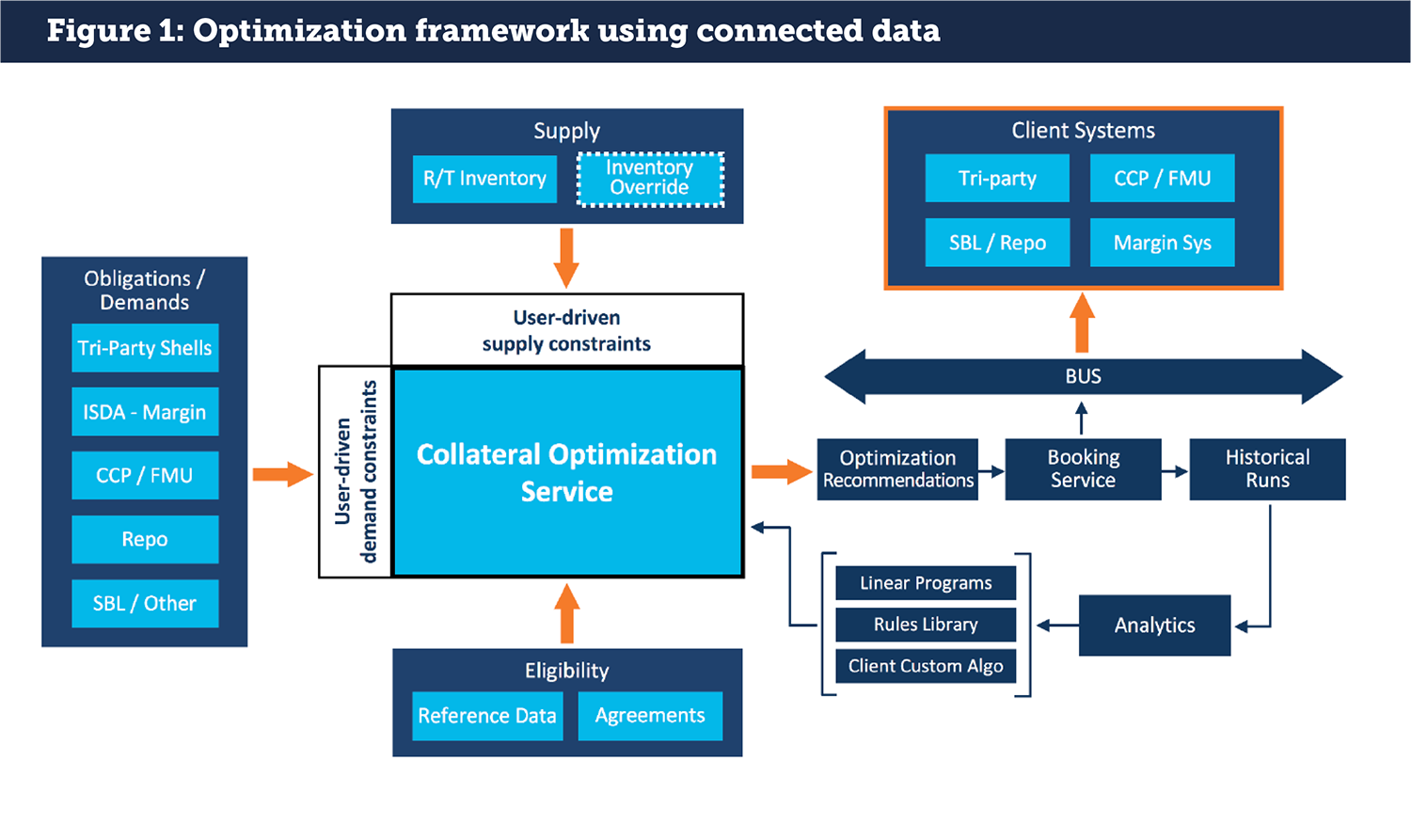
The next level of collateral optimization considers connected data in collateral calculations. Interest is being driven by better technology that can more precisely track financial performance in real time. A finely tuned understanding of the nature of the individual positions and how they impact the firm can in turn mandate a new kind of collateral optimization methodology that structures cheapest to deliver based on a combination of performance impacting factors and market pricing. This gives a new meaning to “best collateral” for any given margin requirement. This only becomes possible when connected data is integrated into the collateral optimization platform.

As an example of applying connected data, not all equities are the same on a balance sheet. A client position that must be funded has one implication while a firm position has another. Both bring a funding and liquidity cost. A firm long delivered against a customer short is internalization, which has a specific balance sheet impact. Depending on balance sheet liquidity, this impact may need additional capital to maintain. Likewise, an expected tenor of a position will impact liquidity treatments. A decision to retain or host these different assets as collateral can in turn feedback to Liquidity Coverage Ratio, Leverage Ratio and other metrics for internal and external consumption.

If these impacts can be observed in real-time, the firm may find that internalizing the position reduces balance sheet but is sub-optimal compared to borrowing the collateral externally. This of course carries its own funding and capital charges, along with counterparty credit limits and risk weightings in the bilateral market. These could in turn be balanced by repo-ing out the firm position, and by tenor matching collateral liabilities in line with the Liquidity Coverage Ratio and future Net Stable Funding Ratio requirements. Anyone familiar with balance sheet calculations will see that these overlapping and potentially conflicting objectives may result in decisions that increase or decrease costs depending on the outcome. By understanding the connected data of each position, including available assets and what needs to be funded, firms can make the best possible decision in collateral utilization. Importantly, the end result is to reduce slippage, increase efficiency, and ultimately deliver greater revenues and better client pricing based on smarter balance sheet management.

Another way to look at the new view of collateral optimization is as the second derivative. The first derivative was the ordering of lists or observation of collateral schedules. The next generation incorporates connected data across collateral holdings and requirements for a more granular understanding of what collateral needs to be delivered and where, and how this will impact the balance sheet and funding costs. It has taken some time to build the technology and an internal perspective, but firms are now ready to engage in this next level of collateral sophistication.

Implementing technology for connected data in collateral and liquidity

A connected data framework starts with assessing what data is available and what needs to be tagged for informing the next level of information about collateral holdings. This process is achievable only with a scalable technology solution: it is not possible to manage this level of information manually let alone for real time decision making. Building out a technology platform requires careful consideration of the end to end use case. If firms get this part right, they can succeed in building out a connected data ecosystem.

The connected data project also requires access to a wide range of data sources. Advances in technology have allowed data to be captured and presented to traders, regulators, and credit and operations teams. But right now, most data are fragmented, looking more like spaghetti than a coherent picture of activity across the organization. To be effective, data needs to flow from the original sources and be readable by each system in a fully automated way.

Once a usable, tagged data set has been established, it can then be applied to collateral optimization and actionable results. This can include what-if scenarios, algorithmic trading, workflow management, and further to areas like transfer pricing analytics. Assessing and organizing the data, then tagging it appropriately, can yield broad-ranging results.

Building out the collateral mindset

An evolution in the practice of collateral optimization requires a more holistic view of what collateral is supposed to do for the firm and how to get there. This is a complex cultural challenge and is part of an ongoing evolution in capital markets about the role of the firm, digitization and how services are delivered. While difficult to track, market participants can qualitatively point to differences in how they and their peers think about collateral today versus five years ago. The further the past distance, the greater the change, which naturally suggests challenges when looking at a possible future state.

An important element to developing scalable collateral thinking is the application of technology; our observation is that technology and thinking about how the technology can be applied go hand-in-hand. As each new wave of technology is introduced, new possibilities emerge to think about balance sheet efficiency and also how services are delivered both internally and to clients. In solving these challenges for our clients using our technology, it is evident that a new vision is required before a technology roadmap can be designed or implemented.

The application of connected data for the collateral market is one such point of evolution. Before connected data were available on a digitized basis, collateral desks relied either on ordered lists or individual/manual understandings of which positions were available for which purposes. There was no conversation about the balance sheet except in general terms. Now however, standardized connected data means that every trading desk, operations team and balance sheet decision maker can refine options for what collateral to deliver based on the best balance sheet outcome in near real-time. New scenarios can be run that were never possible, and pricing for clients can be obtained in time spans that used to take hours if not a day or more.

Now that collateral optimization based on connected data is available, this requires firms to think about what services they can deliver to clients on an automated basis, and what should be bundled and what should be kept disaggregated. As new competitors loom in both the retail and institutional space, these sorts of conversations driven by technology and collateral become critical to the future of the business. Connected data is leading the way.

This article was originally published on Securities Finance Monitor.

View and/or download Article PDF

Centralized collateral management becoming a reality

Collateral management has transitioned from an ancillary service to a core competency, largely as a result of the sheer breadth of activity from front to back office and horizontally across silos and asset classes. This has spurred a marked shift towards centralization of collateral management, providing organizations with a centralized view of inventory as well as funding and collateral optimization decisions.

But the move to a more efficient and centralized model is not without challenges. Inefficiencies and the cost of errors are magnified by the multiplicity of internal and external relationships that need to be managed and the requirement to control positions more frequently, even in real-time.

This requires a fundamental shift from managing assets only for margin purposes to managing assets for value, cost and balance sheet purposes.

Moving to a centralized collateral organization is a difficult step for many reasons and as a result, some firms are decoupling their business organization from their technology capabilities.  They are instead focusing on building a centralized, horizontal technology strategy for inventory and collateral management.

In either case, the end goal may be the same – a holistic infrastructure that can yield the benefits of centralized collateral and inventory management coupled with sophisticated analytics and firm-wide optimization capabilities. Fortunately, today’s technology enables this ultimate goal as well as the smaller moves in this direction.

Steps to collateral optimization

Regardless of the approach taken, there are a number of best practices for firms looking to increase the efficiency of their collateral and liquidity management:

  1. Achieve visibility into inventory across multiple business lines and regions. This centralized view is extremely important.
  2. Ensure all collateral schedules and legal agreements are easily accessible as these will impose constraints on decision-making.
  3. Take a centralized view of different types of obligations and requirements to enable good decision-making.
  4. Establish targeted analytics and Key Performance Indicators (KPIs) to measure and monitor progress of these initiatives.

These are vital foundational steps towards achieving an optimized collateral management environment.

Connected data: The key to better decision-making

Of course, bringing the data together is just one part of the process – the next step is to connect the data so that algorithms and analytics can be applied to it. Firms understand that the information is there for them to make better decisions, but they face a challenge in getting useable information and putting it to work.

The main obstacle, in most cases, is that they have built their operational structures and technology around specific areas of the business. To achieve a view across the whole enterprise, these businesses require coordination and connectivity across a large number of different internal and external systems – not easy to accomplish.

The solution lies in implementing a system that is easy to integrate and is targeted at connecting and harmonizing this data.

Avoiding costly re-engineering

There are sometimes negative connotations around the phrase ‘legacy technology’ but this is not always accurate. A firm’s existing securities lending or repo or margin systems may be good, but they will more often than not have been built as separate systems. Rather than re-engineering all these systems, what the firm needs is a layer that pulls these disparate systems together to ensure they are seeing a holistic and harmonized view of inventory, positions and obligations.

Most firms have taken some steps to improve their inventory management, but there is a wide difference across the industry in terms of the strategies adopted to achieve this objective. Some organizations are trying to address the issue in a tactical way, fixing one system at a time to see whether this gives them greater visibility, but this approach does not have much longevity from a strategic perspective.

The larger organizations have usually taken a more strategic approach. Some see it as primarily an internal engineering effort, while others are talking to firms such as Transcend as they seek to harness real-time data, collateral and liquidity.

Regardless of the approach taken, being able to optimize collateral and liquidity decisions at an enterprise level has huge benefits. The sheer number of firms and analysts that have explored the scale of these benefits underlines the significance of the opportunity, and we find that most firms are actively taking steps towards achieving these capabilities.

Optimization models can be implemented with a rules-based approach or even using more sophisticated algorithms (i.e. linear and non-linear programming models). These all have a vital role to play in monetizing the connected data across the firm.

Scaling the benefits

Being able to optimize collateral across business lines is an obvious benefit, but there are also advantages to be gained from reducing internal errors and fail rates. In addition, funding costs will fall because firms will be managing their funding operations more efficiently: improving securitized funding leads to a reduction in more expensive, unsecured funding.

Whether or not firms embrace centralization across all aspects of their business, it is clear that rationalizing complex systems and harnessing fragmented data sets provides for informed, confident and compliant decision-making. And once centralized funding and collateral management are fully achieved, the benefits of efficiency, cost-savings and liquidity attain even greater scale for the firm.

This article was originally published on Global Investor Group.

View and/or download Article PDF

Collateral management: A path littered with obstacles

As collateral rules have grown in complexity, so has the need for greater optimization – But as Tim Steele [of Funds Europe] discovers, achieving that can be painful.

Collateral has long been used as a tool for mitigating counterparty risk and obtaining credit, but now more than ever, it is the key determinant of an institution’s ability to engage in financial transactions in the cash or derivatives markets….

“If you optimize every pool or silo individually, as a firm you will by design not be optimized,” says Bimal Kadikar.

Read the full article from Funds Europe

Building a Holistic Collateral Infrastructure

Following the financial crisis, regulations and their associated reporting have created an opportunity for banks and investment firms to create a single, unified collateral infrastructure across all product siloes. This does not have to be a radical architecture rebuild, but rather can be achieved incrementally.

There are legitimate historical reasons why collateral infrastructure has grown up as a patchwork of systems and processes. For products such as stock lending, repo, futures or contracts for difference (CFDs), the collateral/margining process was generally integral to the products and processing systems. It would not have made sense to break out collateral management into a separate group and hence operating teams and systems were structured around the core product unit. Generally, only OTC derivatives had a relatively clear decoupling between collateral management and other operational processes. Even as business units merged at the top level, this product separation at the collateral management level often continued.

While this situation could stand during non-stress periods, the financial crisis demonstrated the fallacy that siloed, uncoordinated collateral management systems, data and processes could weather any storm. This disjointed view caused a number of specific problems, including: an inability to see the full exposures to counterparties; a lack of organization in cash and non-cash holdings; and substantial inflexibility in mobilizing the overall collateral pool. Even before the crisis, inconsistent or “zero cost allocation” for collateral usage meant that collateral was not always being directed to the parts of the business that needed it most. After the crisis, with collateral and High Quality Liquid Assets at a premium, this became unacceptable.

Today, few banks and investment firms have completed the work of integrating their collateral management functions across products (see Exhibit 1). Some of the largest banks are focused on building capabilities to achieve enterprise-wide collateral optimization, while others are just starting on this effort, at least on a silo basis. Some have bought or built large systems with cross-product support, although this has proven costly. Others are evaluating organizational consolidation. Whatever their current state, a new round of regulatory reporting requirements in the US and Europe means that letting collateral infrastructure sit to one side is no longer viable to meet business or compliance objectives without adding substantial staff. One way or another, long-term solutions must be achieved.

Exhibit 1: Moving past the siloed approach

Source: Transcend Street Solutions

The next round of regulatory impact

While nearly all large firms have digested the current waves of regulatory reporting and collateral management requirements, the next round will soon be arriving. Among these are the Federal Reserve’s regulation SR14-1, MiFID II (Revision of the Markets in Financial Instruments Directive), and the Securities Finance Transactions Regulation (SFTR). It is worth looking at some of these requirements in detail to understand what else is being demanded of collateral management infrastructure and departments.

The Federal Reserve’s regulation SR14-1 is aimed at improving the resolution process for US bank holding companies. It includes a high level requirement that banks should have effective processes for managing, identifying, and valuing collateral it receives from and posts to external parties and affiliates.[1] At the close of any business day banks should be able to identify exactly where any counterparty collateral is held, document all netting and rehypothecation arrangements and track inter-entity collateral related to inter-entity credit risk. On a quarterly basis they need to review CSAs, differences in collateral requirements and processes between jurisdictions, and forecast changes in collateral requirements. Also on the theme of improved resolution rules are the record keeping requirements related to “Qualified Financial Contracts” (effectively most non-cleared OTC transactions).[2] These require banks to identify the details and conditions of the master agreements and CSAs applying to the relevant trades.

While the regulatory intent is understandable, these requirements are exceptionally difficult to meet without a unified collateral infrastructure. There is in fact no way to respond without a single, holistic view of collateral and exposure across the enterprise. While SR14-1 impacts only the largest banks, it still means these banks have a mandate to complete the work they have begun in organizing their vast collection of collateral information. This will lead to greater collateral opportunities for the big banks, and may in turn encourage smaller competitors to complete the same work in order to exploit similar new efficiencies.

Article 15 of Europe’s SFTR places restrictions on the reuse of collateral (rehypothecation). The provider of collateral has to be informed in writing of the risk and consequences of their collateral being reused. They also have to provide prior, express consent to the reuse of their collateral. Even with the appropriate documentation and reporting in place, a collateral management department has to carefully ensure that the written agreement on reuse is strictly complied with. While nothing is written in the US yet, market participants believe that the US Office of Financial Research will soon require mandatory reporting that may entail overlapping requirements.

Similarly, MiFID II introduces strict restrictions on the use of customer assets for collateral purposes and potentially has a major impact on collateralized trading products. A complicated analysis must be conducted on best execution, but in OTC and securities financing markets, best execution may be a function of term, price, counterparty risk and/or collateral acceptance. Further, any variation from a standard best price policy needs to be documented to show how the investment firm or intermediary sought to safeguard the interest of the client.

SFTR and MiFID II require that banks rethink their entire reporting methodologies, and in some cases must rethink parts of their business model. A wide range of new information must be captured, analyzed, consolidated, and reported outwards and internally. This will likely generate new ideas and business opportunities around collateral usage and pricing for those firms that can digest the large quantities of new information that will be produced.

A holistic foundation for trading, control, MIS and regulatory reporting

The struggle at many firms to comply with regulations while maximizing profitability has led to two parallel sets of infrastructures: one for the business and another for compliance. This creates two levels of cost that duplicate substantial effort inside the firm. Along the way, business lines get charged twice for this work as costs are allocated back to the business. This is an immediate negative impact on profitability; even firms that have completed collateral optimization immediately lose a piece of that financial benefit.

The cumulative impact of regulation means that banks and investment firms generally cannot afford to wait for consolidation projects to deliver a single integrated platform. The fragmentation of teams, data and processes are hurdles for any institution to overcome but so is the old mindset that simply thinks of collateral management as an isolated operational process.

We identify five critical areas for firms to address in order to create a foundation for their holistic collateral infrastructure:

  • Map the full impacts of regulatory and profitability requirements on businesses, processes, and systems.
  • Recognize that collateral management is an integral part of many key activities at the firm including trading and liquidity management.
  • Understand the core decision making processes at the heart of effective collateral management.
  • Organize and manage the data that is required to drive those processes.
  • Build a functional operating model for collateral management.

The fifth recommendation, building a functional operational model for collateral, means being able to connect together disparate business lines to provide an enterprise view of collateral. It includes mining collateral agreements to make optimal decisions or decisions mandated by regulation. It requires the ability to perform analysis of collateral to balance economic and regulatory drivers, and it requires controls and transparency of client collateral across all margin centers.

At Transcend Street Solutions, we are actively working with our clients to help them develop a strategic roadmap of business and technology deliverables to achieve a holistic collateral infrastructure. While there are always organizational as well as infrastructural nuances in every business, we have seen the framework proposed above yield a positive return for our clients. Our technology platform, CoSMOS, is nimble, modular and customizable to accelerate collateral infrastructure evolution without necessarily having to retire existing systems or undergo a big infrastructural lift.

Getting this right is important for more than just regulatory compliance. It means the collateral function and trading desks can perform the forward processes required to support both profitable trading and firm-wide decision making. Pre-trade analytics is needed to ensure that collateral is allocated optimally across portfolios and collateral agreements. Optimization is also needed at the trade level to ensure the most suitable collateral is applied to each trade or structure. Finally, analysis needs to be carried out across the whole inventory of securities and cash positions to ensure collateral is used by the right businesses. After all, correct pricing of collateral across business lines is not only essential for firm-level profitability but also incentivizing desirable behavior throughout the organization.

We strongly believe that firms that are successful in achieving a holistic collateral architecture will have a significant competitive advantage in the industry. They will be able to achieve optimization of collateral and liquidity across business silos while meeting most global regulatory requirements, and all that with a much more efficient IT spend.

This article was originally published on Securities Finance Monitor.